Reconstituted Veneers
Reconstituted veneer faithfully reproduces the look of fine wood while offering a uniformity of colour and grain impossible to achieve with raw material. A reliable, cost-effective solution for projects that demand perfect consistency from panel to panel.
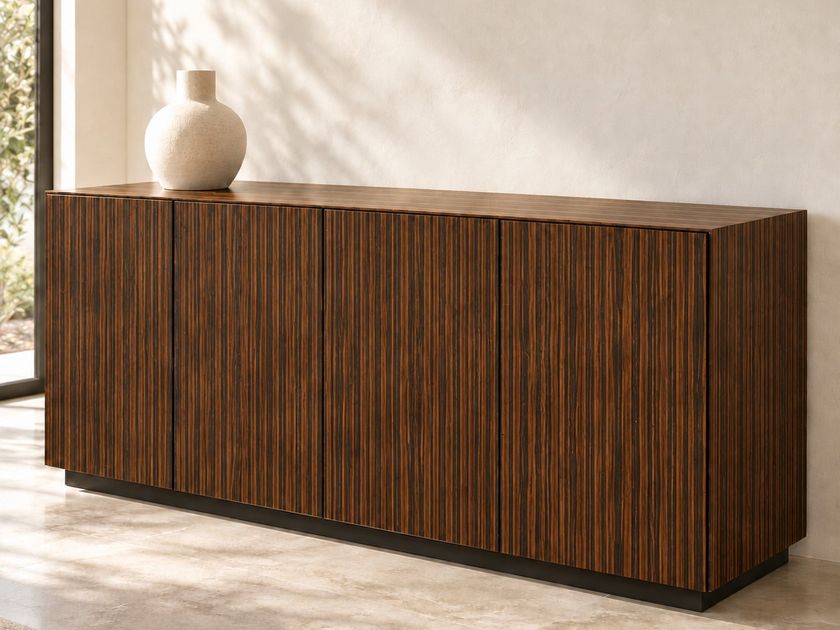
Natural or Reconstituted Veneer: How to Choose?
The choice between natural and reconstituted veneer depends mainly on the desired look, the type of project and production constraints. Here are the key differences in how each is used.
1. Repeatability and Large-Scale Projects
Ideal for large spaces, mass-produced office furniture or hotel fit-outs. Since the sheets are identical, grain and colour stay perfectly uniform from one panel to the next.
Reserved for one-of-a-kind pieces or fine cabinetry. Each sheet is unique (figure, knots, colour variation), requiring careful matching (book-matched, slip-matched) to harmonize the panels.
2. Complex Shapes and Flexibility
More flexible and consistent since it contains no knots or structural defects. Easier to apply on curved surfaces or sharp angles without risk of splitting.
More rigid and sometimes brittle depending on the species chosen (such as burls). Handling it requires greater technical expertise when pressing onto complex shapes.
3. Machining and Shop Finishing
Its colour is impregnated throughout (dye immersion). Light sanding leaves the colour unchanged. It often requires less sealer, since its porosity is well controlled.
Sensitive to excessive sanding, which can quickly go through the sheet. It reacts uniquely to stains, oils and finishes, offering an organic visual depth impossible to replicate artificially.
4. Durability and Ageing Over Time
Often more sensitive to UV rays (fading) due to the artificial dyes used, although modern finishes now include effective UV filters.
Develops a natural patina over time. It gains character and shifts in tone under the effect of light, a quality prized in high-end furniture.