Laminating Wood Veneer Without Warping or Telegraphing
The choice of substrate, adhesive, and press method alone determines the strength, durability, and final appearance of a laminated panel — whether the backing is raw, paper (Paperback), polymer (Polyback), or phenolic laminate.
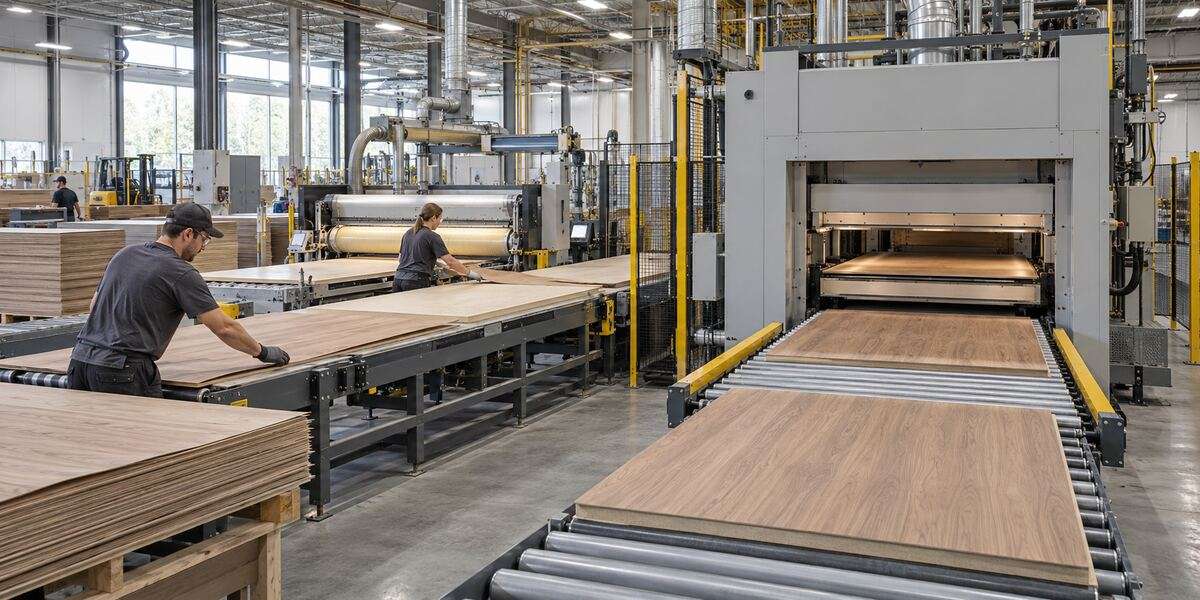
01 — Choosing the Substrate
The substrate is what prevents warping, blistering, and telegraphing — imperfections in the support that show through the veneer. Manufactured composite materials remain the best choice for their flatness and dimensional stability.
Wood-Derived Composite Panels
Most Recommended| Substrate | Description |
|---|---|
| MDF | The gold-standard substrate. Ultra-smooth, uniform, porous surface for ideal glue bonding and zero risk of telegraphing, even with thin (10-mil) paper. |
| Particleboard | Economical and stable, suited to hot or cold presses. A thicker backing (Polyback or phenolic laminate) is recommended to mask the granular texture. |
| HDF | Similar to MDF but denser and thinner — often used for flooring or thin wall panels. |
Combined Plywood and Engineered Panels
| Substrate | Description |
|---|---|
| Hardwood-core plywood | Excellent screw retention and high structural rigidity. Birch or poplar is preferred for its more even surface. |
| Combination panels | Known as "Ultra Core" — a plywood core for lightness and rigidity, wrapped in thin MDF surfaces for a perfectly smooth veneer. |
Special and Architectural Applications
| Substrate | Description |
|---|---|
| Fire-rated panels | Chemically treated fire-rated MDF or particleboard. Mandatory on certain commercial and architectural projects. |
| Moisture-resistant panels (MR) | Designed for humid environments (bathrooms, kitchens). Ideally paired with a phenolic or Polyback backing as a moisture barrier. |
Gluing a Polyback- or Phenolic-Backed Veneer to These Panels
Polyback (polymer) and phenolic (laminate) backings both protect the veneer well, but neither is very porous — and neither are the moisture-resistant and fire-rated panels they're most often paired with. Glue selection needs to account for that.
Moisture-Resistant Panels
Green MDF · MR particleboardLiquid polyurethane (PUR) glue — cures with moisture, bonds perfectly to Polyback, phenolic laminate, and moisture-resistant additives, 100% waterproof. Urea-formaldehyde glue is also a solid industrial press option: rigid bond, no creep.
Solvent-based contact cement, industrial grade. Avoid water-based formulas — they adhere poorly to the synthetic backing (Polyback or phenolic) and the treated panel. Never use a water-based glue.
Vinyl glues (PVA) and unmodified cold-press veneer glues: they need two porous surfaces to dry, and neither the Polyback/phenolic backing nor the moisture-resistant panel provide that. Risk of peeling or blistering.
Fire-Rated Panels
Fire-rated MDF · particleboardLiquid polyurethane (PUR) glue — water-free, so it won't draw the fire-retardant salts to the surface and compromise the bond, whether the backing is Polyback or phenolic. Urea-formaldehyde (UF) glue also holds up well to heat; check catalyst compatibility with the panel's fire treatment.
Neoprene contact cement, solvent-based — the Polyback or phenolic backing keeps the solvent from passing through and damaging the veneer. Never use a water-based glue.
PVA glues: their water content draws the fire-retardant salts to the surface, causing blistering and quick delamination.
⚠️ Important: paper-backed veneer (Paperback) is not recommended on a moisture-resistant or fire-rated panel. Too thin and porous, it blocks neither residual moisture nor the treatment salts, which can migrate to the surface and blister the bond. Always reserve a Polyback or phenolic backing for these panels.
Sanding and dust removal: a light pass with 100–120 grit sandpaper on the backing — Polyback or phenolic — and on the panel creates the mechanical bite the glue needs. Wipe down dry — never with water, especially on a fire-rated panel, so as not to activate the treatment salts.
Counter-balancing: as with any panel, glue a veneer or balancing paper to the opposite face to keep the panel from warping under tension.
Metals and Plastics — Non-Porous Substrates
A robust phenolic laminate or Polyback backing chemically isolates the veneer from the support and allows bonding to non-porous surfaces, provided the right adhesive is used (industrial contact cement, PUR, or epoxy).
| Material | Note |
|---|---|
| Aluminum / structural steel | Sheets used as-is, with no porosity to anchor the glue. |
| Rigid plastic / expanded PVC | Lightweight, dimensionally stable support. |
| FRP | Fiberglass-reinforced plastic — institutional sector or recreational vehicles. |
Solid wood: avoid as a direct support. It moves constantly with humidity, which eventually shears the glue line and cracks or lifts a thin veneer.
OSB panel (waferboard): too irregular and bumpy a surface. Large wood chips inevitably telegraph through the veneer.
02 — Adhesives and Press Methods
Whether the veneer is raw, paper-backed, Polyback, or laminated, the glue-and-press-method combination determines the strength, durability, and final appearance of the panel.
Types of Veneer Adhesives
| Adhesive | Use | Advantages | Drawbacks |
|---|---|---|---|
| PVA | The most common in cabinetmaking. Yellow glue (Type II/III) resists moisture better. | Economical, cleans up with water, excellent adhesion on porous substrates. | Contains water — can cause a very thin raw veneer or Paperback to buckle if applied too generously. Avoid on metal or plastic. |
| Contact cement (neoprene) | Manual bonding, curved surfaces, job sites without a press. | Instant bond with no clamping time. Ideal with a robust phenolic laminate or Polyback backing. | Allows no readjustment. Less resistant to extreme heat and finishing solvents. |
| Polyurethane (PUR) | Reactive adhesive that cures with ambient humidity. | Absolute resistance to water and heat. Bonds veneer to non-porous substrates (metal, aluminum, plastic). | Difficult to clean once cured; requires firm pressing. |
| Urea-formaldehyde (UF) | The industry standard for hot or vacuum presses, sold as a powder to mix. | Becomes extremely hard when dry — eliminates any risk of glue creep. Ideal for high-end finishes. | Requires a perfectly flat substrate; emits VOCs (volatile organic compounds) modern formulas are tightly controlled. |
Press and Clamping Methods
| Method | Principle | Applications |
|---|---|---|
| Vacuum press | The panel and glued veneer slide into an airtight bag; a pump creates a vacuum that presses the piece evenly (up to 14 psi). | Artisan or architectural cabinet shops, curved pieces, moldings. Used with PVA or UF glue. |
| Hot press | Industrial hydraulic press with heated steel platens (80–130°C / 175–265°F) applying very high mechanical pressure. | Industrial series production. Cures in 1 to 3 minutes instead of several hours — the go-to method for MDF at scale. |
| Mechanical cold press | Glued panels are stacked, then compressed with hydraulic jacks or clamping screws, with no heat. | Flat hardwood panels or veneers with PVA glue. Longer clamping time (30 minutes to 2 hours). |
| Roller lay-up | No permanent clamping tool — a heavy roller applied by hand forces out the air. | Exclusively with contact cement. Ideal for applying flexible paper-backed or Polyback veneer directly on a job site. |
03 — Recommendations by Configuration
The target surface — flat or curved — drives every other choice: substrate, glue, and press method don't combine the same way in both cases.
Flat Surfaces
Output / QualityMDF or particleboard. Avoid standard plywood, which can develop slight surface waviness.
Hot press in industrial settings; vacuum or cold press in the shop.
Urea-formaldehyde or PVA (yellow) — these become rigid when dry, preventing any slippage over time.
Always veneer both sides of the panel with veneer of equal strength and thickness. Veneering only one side will cause the panel to bow irreversibly.
Curved Surfaces
FlexibilityPaperback (10 or 20-mil) for tight radii; Polyback, since the polymer stretches slightly. Avoid: raw veneer with no backing and phenolic laminate, both too rigid.
Bendable plywood (Lauan) or machined MDF (routed/grooved) that flexes easily.
Vacuum press — the bag conforms perfectly to the contours and applies uniform pressure (14 psi) across the entire curve.
Contact cement with vigorous manual roller lay-up, ideal for a large radius (e.g., a rounded reception counter) directly on site.
Decision Summary
The three most common configurations, at a glance.
| Configuration | Ideal Substrate | Recommended Backing | Adhesive | Clamping Method |
|---|---|---|---|---|
| Flat — output | MDF | Laminate or Polyback | Urea-formaldehyde or PVA | Hot press / cold press |
| Curved — shop | Thin / bendable MDF | Paperback or Polyback | PVA | Vacuum press |
| Curved — job site | Flexible plywood | Paperback | Contact cement | Roller lay-up |
04 — Hot Press Parameters
To successfully hot-press wood veneer onto panels (MDF, particleboard, or plywood), three fundamental parameters must be set with precision: temperature should range between 90°C and 130°C, pressing time runs from 1 to 5 minutes, and pressure must be maintained between 0.8 and 1.5 MPa (115–220 PSI).
Here is the technical detail behind each factor, so you can fine-tune your settings to your materials.
🌡️ Required Temperature
Temperature depends mainly on the type of glue used. Since wood is an insulator, heat from the platens must migrate through the veneer to activate and cure the adhesive.
| Glue type | Temperature range |
|---|---|
| Urea-formaldehyde (UF) | 90°C – 110°C — the industry standard for wood veneer. |
| PVAc (high-performance thermosetting white glue) | 70°C – 90°C. |
| Polyurethane (PUR) / phenolic resins | 120°C – 140°C. |
Caution: too high a temperature (above 140°C) risks boiling the wood's residual moisture, creating blisters (bubbles) under the veneer.
⏱️ Pressing Time
The cycle depends on veneer thickness and how quickly the glue cures.
- Standard thin veneer (0.6 mm): 1.5 to 3 minutes is usually enough.
- Supplier's technical data sheet: always check your glue supplier's technical data sheet before laminating anything — exact pressing parameters vary by formulation.
Tip: don't press longer than necessary — over-pressing dries the wood excessively and can cause checking (cracks) as it cools.
⚖️ Required Pressure
Pressure must be even to ensure perfect contact without crushing the wood fibers. It's set according to the density of the veneer species and the substrate panel.
| Wood species | Recommended pressure |
|---|---|
| Softwoods (poplar, okoume, pine) | 0.8 – 1.0 MPa (8–10 bar / ~115–145 PSI). |
| Hardwoods / dense species (oak, maple, ash) | 1.2 – 1.5 MPa (12–15 bar / ~175–220 PSI). |
Risk: too little pressure causes areas of delamination. Excessive pressure (over 2.0 MPa) forces glue to bleed through the veneer's pores, blocking future finishing (varnish or stain).
🛠️ Other Critical Factors to Monitor
- Wood moisture content: veneer sheets must have a moisture content between 6% and 9%. If the wood is too damp, trapped water vapor creates air bubbles that won't release when the press opens.
- Assembly (open) time: once glue is rolled on, the panel must go under press quickly, before the glue begins to skin over.
- Cooling: let panels rest flat and stabilize to room temperature for 24 hours after leaving the press, before cutting or sanding.
Once the panel is veneered and pressed, all that's left is to finish the edges with a matching edge band, or build it into a custom wood frame. For curved surfaces and tight radii, also see our flexible wood veneer.