What Is Wood Veneer?
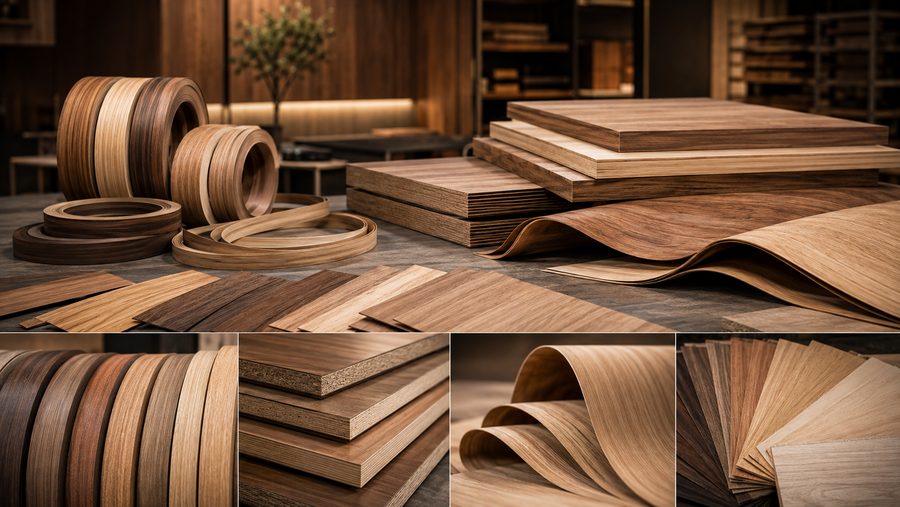
A wood veneer is a thin sheet of real wood, typically 0.5 to 3 mm thick, sliced or peeled directly from a log and then glued onto a support panel (MDF, plywood, particleboard). It gives a manufactured panel the exact look of solid wood, at a fraction of the cost and weight.
Veneer or Plating?
This is the most common source of confusion in French, where the words "placage" (veneer) and "plaquage" (plating) are easily mixed up — but the answer is simple: in woodworking, the correct term is always "placage." The word "plaquage" refers to an entirely different process: depositing a thin layer of metal (gold, chrome, nickel) onto another metal, as in a gold-plated piece of jewelry. In English, the distinction is just as clear — a wood veneer should never be confused with metal plating. For wood, it's always veneer.
Marquetry or Parquetry?
Two similar-sounding words that refer to different things. Marquetry is a decorative technique that involves assembling veneer sheets of different species, tones, or colors to create an artistic composition or pattern on a piece of furniture, panel, or object. Parquetry, on the other hand, refers to assembling pieces of wood to cover a floor — in other words, laying parquet flooring. The two techniques share common origins, but one adorns furniture and vertical surfaces, while the other covers the floor.
Natural or Reconstituted Veneer?
There are two main families of wood veneer, depending on whether it comes directly from a log or is recomposed in a factory.
| Type | Description |
|---|---|
| Natural veneer | Sliced or peeled directly from a real log. Every sheet has a unique grain, tone, and figure — no two sheets are ever identical. See our natural veneers → |
| Reconstituted veneer | Made by dyeing and recomposing thin strips of wood (often poplar or okoume) to create a regular, repeatable grain pattern, species after species, panel after panel. See our reconstituted veneers → |
There is also a third option, for curved surfaces: flexible veneer, mounted on a paper or phenolic backing that lets it wrap columns, curved furniture, and rounded trim.
Our sliced veneers are also available in ready-to-install decorative collections: Vintage, Textura, and Rough Sawn.
How Is Wood Veneer Made?
A log is cut into thin sheets using one of these methods, each producing a different grain pattern. For more details, see our Cutting and Matching page.
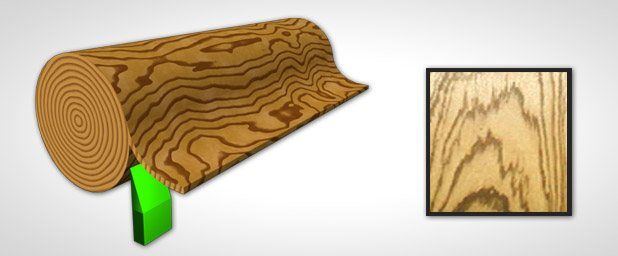
Rotary-Peeled
The log rotates continuously against the blade, much like unrolling a roll of paper — a very high material yield, commonly used for plywood.
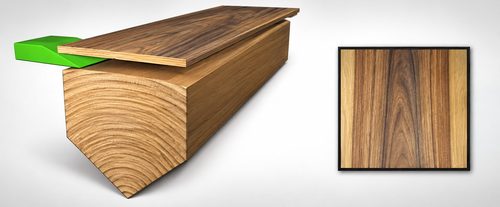
Sliced
The log (or a portion of it) is sliced flat, on quarter, or on rift against a fixed blade — the preferred method for architectural woodworking and high-end furniture, for its controlled grain pattern.
The full detail on cutting and matching techniques (book match, slip match, balanced…) is covered in our cutting and matching guide.
Veneer vs. Solid Wood vs. Plywood: What's the Difference?
| Material | What It Is |
|---|---|
| Solid wood | A solid piece of wood, sawn from the log. Moves significantly with humidity; costly and heavy over large surfaces. |
| Plywood | Several thin layers of wood glued with cross-grain orientation — a structural panel, generally meant to be covered. |
| Veneer | The thin layer of real wood that covers a panel — not a panel in itself, but the visible finish that gives it the appearance of solid wood. |
A single walnut or oak log can produce enough veneer to cover dozens of times the surface it would cover as solid wood — an advantage that's both economic and environmental, while also offering far better dimensional stability than a solid board.
Where Is Wood Veneer Used?
- Architectural panels for walls, ceilings, and interior cladding
- Architectural doors and custom wood frames
- High-end furniture and cabinetry
- Edge banding to finish the edges of a veneered panel
In short: wood veneer is a thin sheet of real wood glued onto a panel — never to be confused with "plating," which refers to a metal process. It can be natural (unique, figured) or reconstituted (regular, repeatable), and it gives a manufactured panel all the beauty of solid wood, with far better stability.